Ancient Mediterranean
These objects from the ancient Mediterranean world represent highlights from the UNC-Wilmington Collection, acquired by the Lam Museum to preserve the legacy of the former Museum of World Cultures.
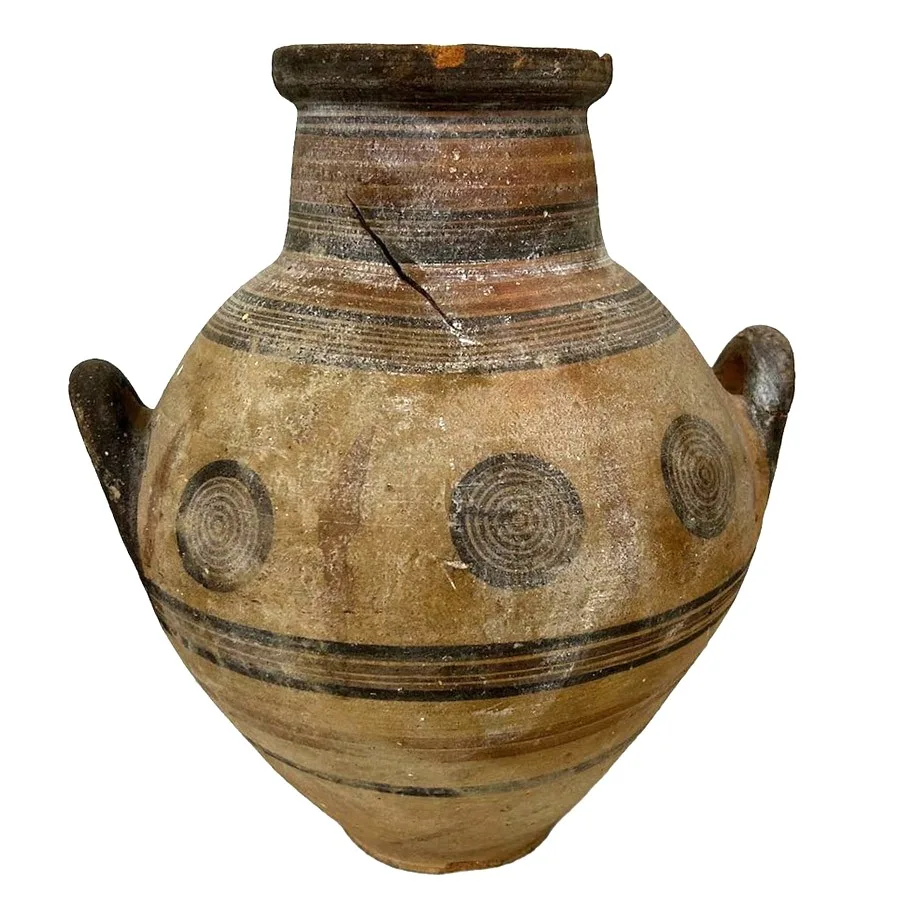
Jar
Cypriot (Archaeological), Greece
#2023.12.E.258 ● Written by Carolina Helmer
This amphora is a special type of jar used to store heavy liquids (such as wine or olive oil) during sea voyages throughout the Mediterranean. This jar was discovered in Greece, but the pottery style more closely resembles the subtle design choices of pottery from Cyprus. The plain design indicates that this jar was designed for daily life, whereas more intricate designs would signify a potential ritualistic use. Stylistically, the decoration on this jar reflects elements of the Archaic and Geometric periods in Cypriot culture during the first millennium BCE.
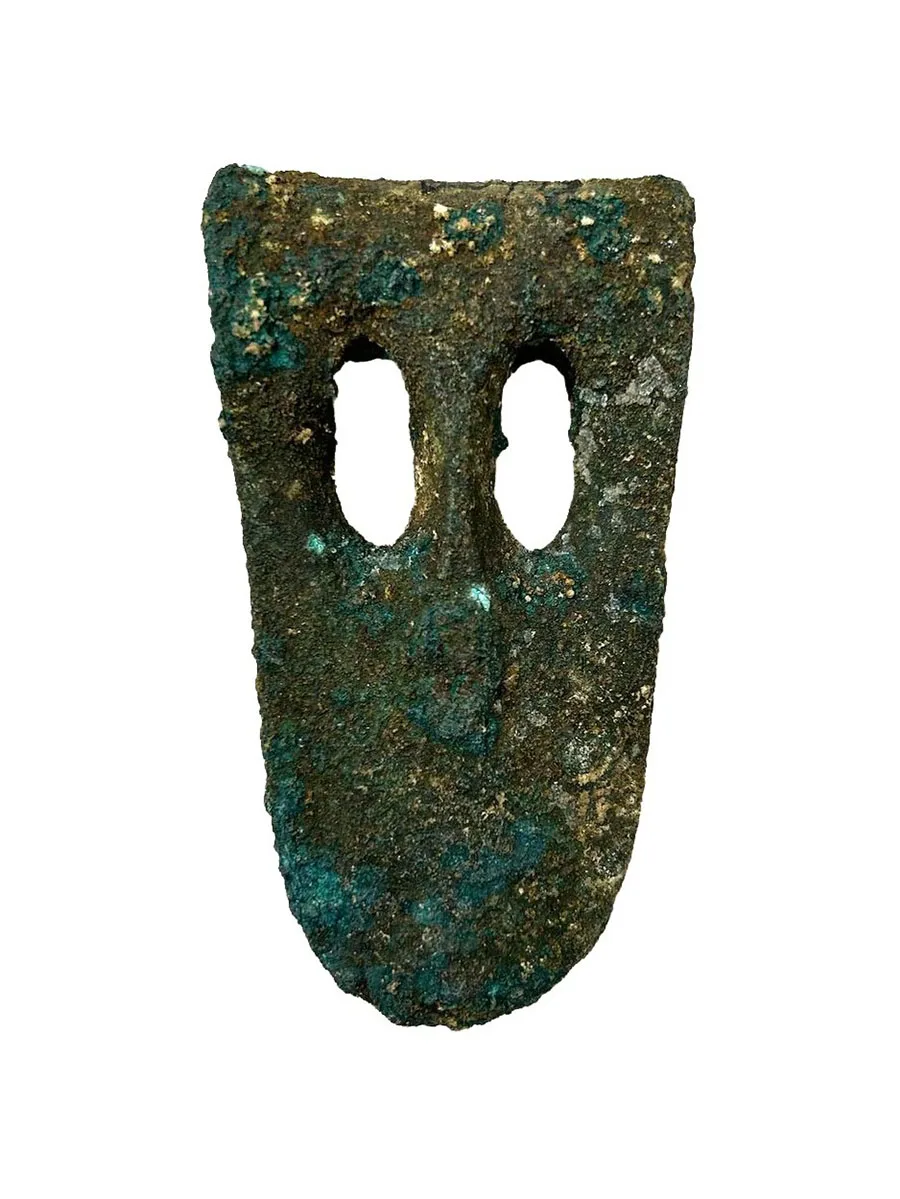
Axe
Canaanite (Archaeological), Israel, Palestine, or Jordan
#2023.12.E.63 ● Written by Shaila Prasad
The “duckbill” axe head originated somewhere in what is present-day Israel, Palestine, Jordan, and Egypt, sometime between 2000 BCE and 10 BCE. Though the object lacks provenance records that specify its details, this general weapon form is well known. The two holes resembling nostrils connected to the haft, allowing for powerful swings that concentrated force on the tapering tip of the “bill.” Axes were used in warfare and as markers of a warrior identity. Elite men were often buried with an axe, along with a dagger, ceremonial belt, and an animal sacrifice.
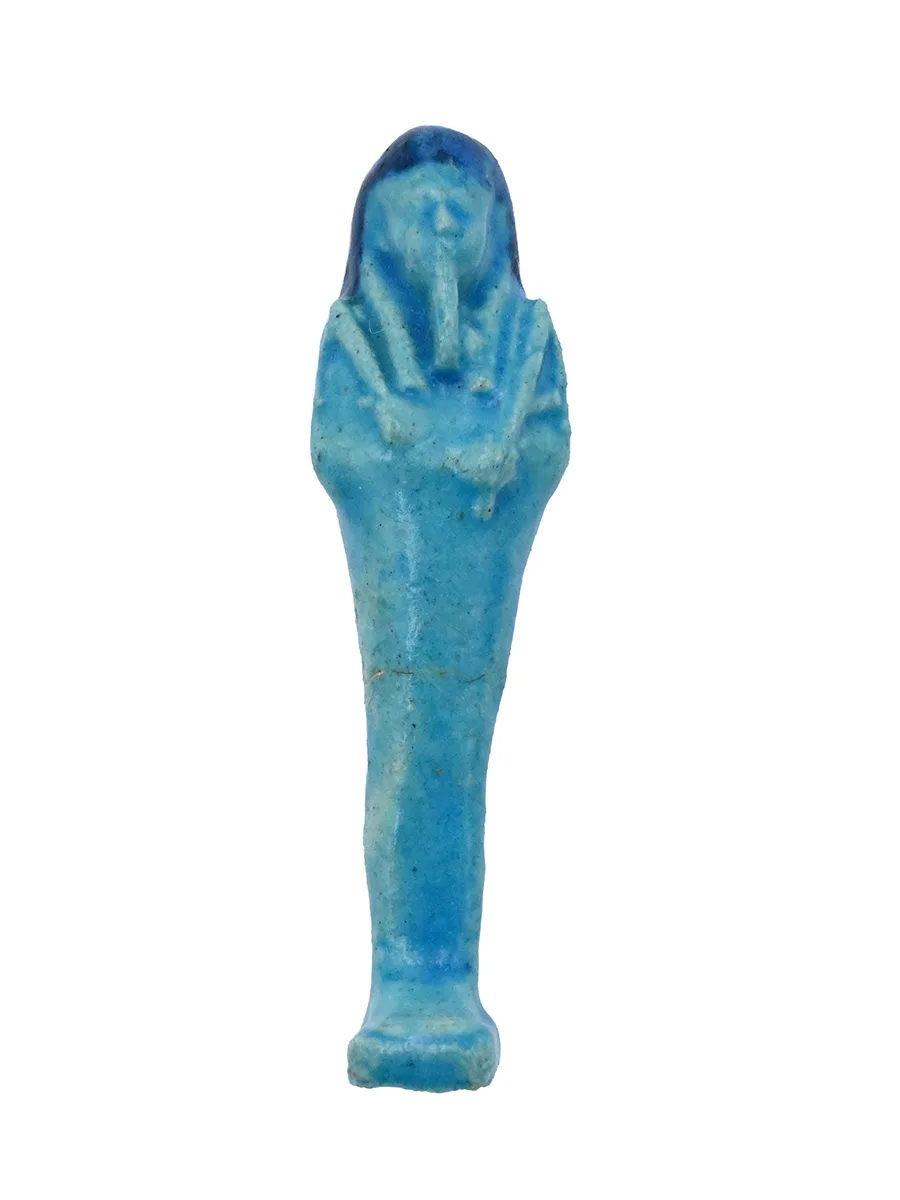
Funerary Sculpture
Egyptian (Archaeological), Egypt
#2023.12.E.31 ● Written by Alexandria Dove-Ali
This glazed ceramic figure is called an ushabti. It likely dates to between 1550 and 332 BCE, a time period encompassing the New Kingdom and Late Period of Ancient Egypt. Ushabtis were placed in tombs to accompany the deceased to the afterlife where they would act as servants and assist with any work done in the afterlife. Many figures hold agricultural tools, as this one does, to perform farm work.
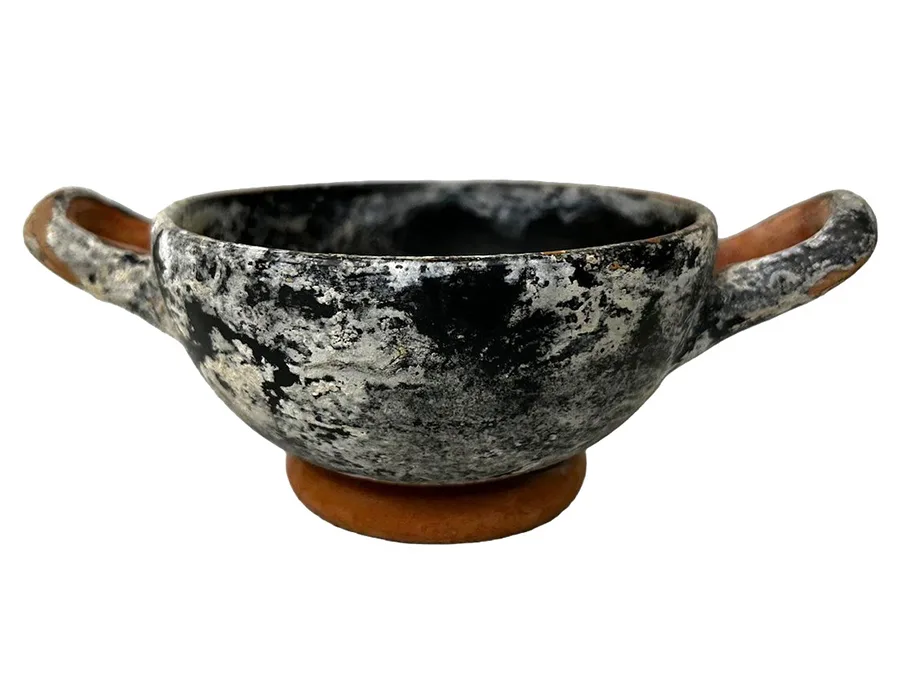
Cup
Greek (Archaeological), Greece
#2023.12.E.216 ● Written by Parker Davis
Used from the sixth through fourth centuries BCE, skyphos were the “wine glasses” of ancient Greek culture. Like most Greek pottery, skyphos were created in workshops by potters who shaped, fired, painted, and sold hundreds of vessels. This black-figure style originated in Corinth but was perfected by artisans from the Attica region. The technique for black-figure pottery involved painting silhouette figures in a black slip on naturally red clay. Then, details were sketched into the slip to reveal the underlying clay color.
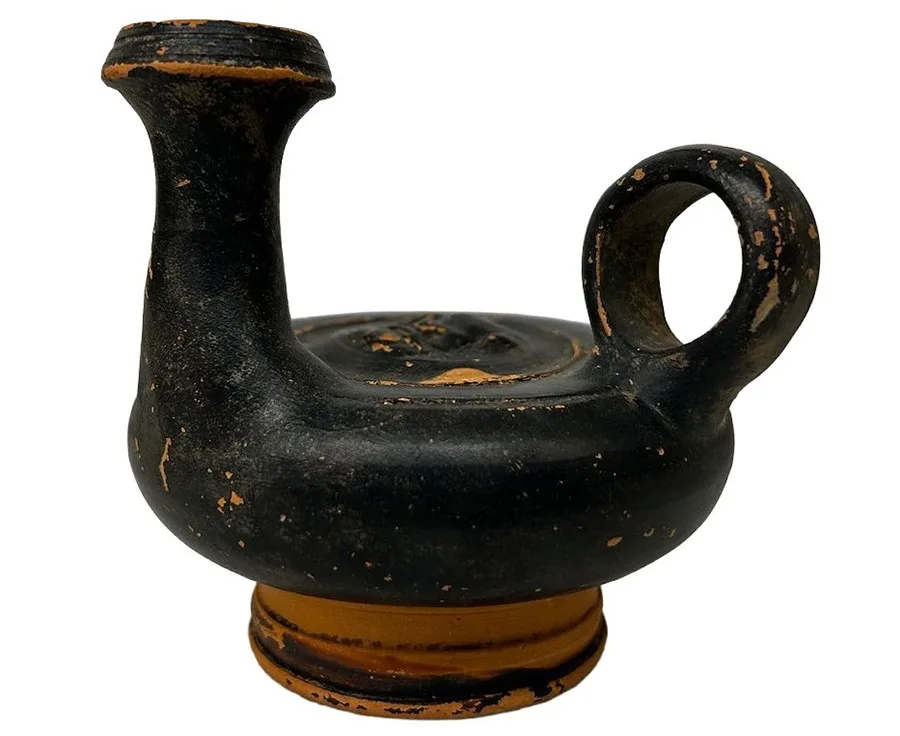
Vessel
Greek (Archaeological), Greece
#2023.12.E.217
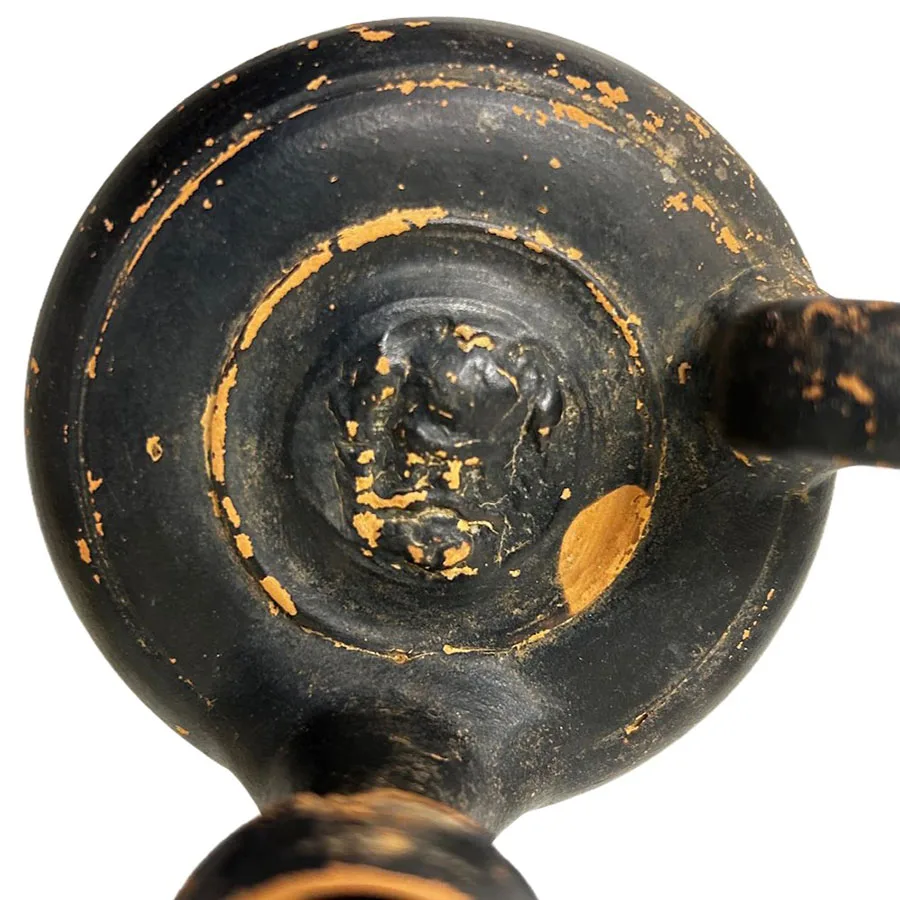
Museum curators identified this ceramic vessel as a guttus, or pouring vessel, based on its bulbous body, small handle on the shoulder, and its narrow, elongated spout. This identification implies the vessel had a ritual function to drop oil or wine during ceremonies, but the artifact may have served any number of utilitarian purposes. The central molded design is of a satyr’s head, which was a popular motif in the 6th and 5th centuries BCE for everyday items such as lamps, pitchers, and jugs.
Clothing Pin
Greek (Archaeological), Greece
#2023.12.E.61 ● Written by Alexandria Dove-Ali
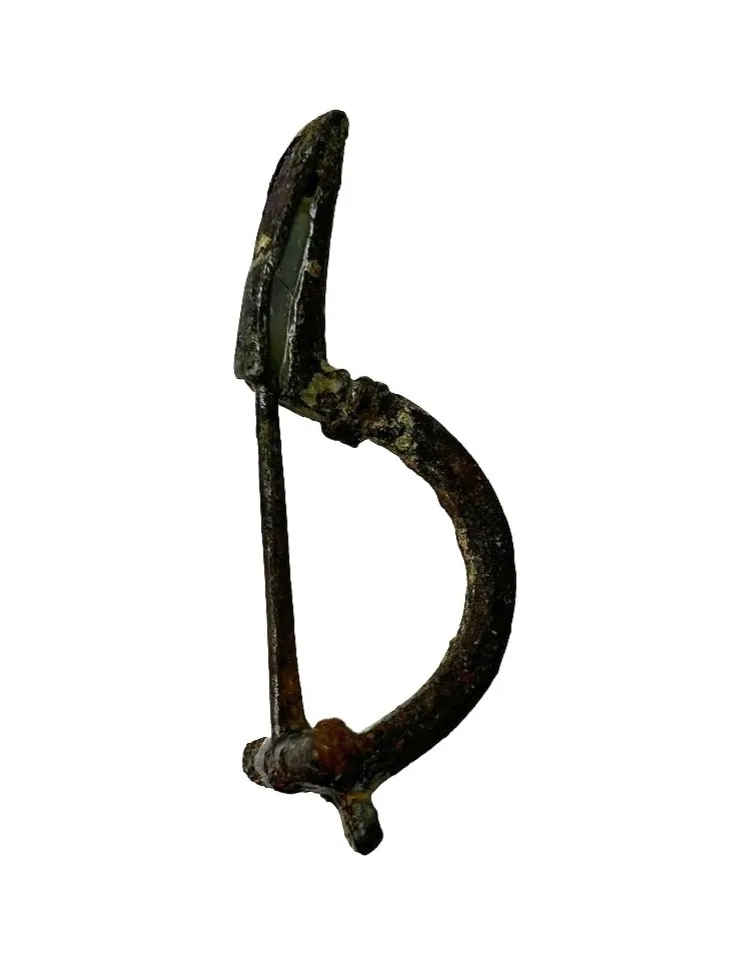
This small metal pin, known as a fibula, is the ancient Greek equivalent of today’s safety pin. Ancient Greek clothing was simple and made from fabrics like linen and wool. The clothing was not sewn. Instead, they were joined together with pins like this one at the shoulders, over the chest, and in other important areas. More decorative fibulae could serve as symbols of social status or power.
Vial
Roman (Archaeological), Italy
#2023.12.E.58 ● Written by Nick Beckom
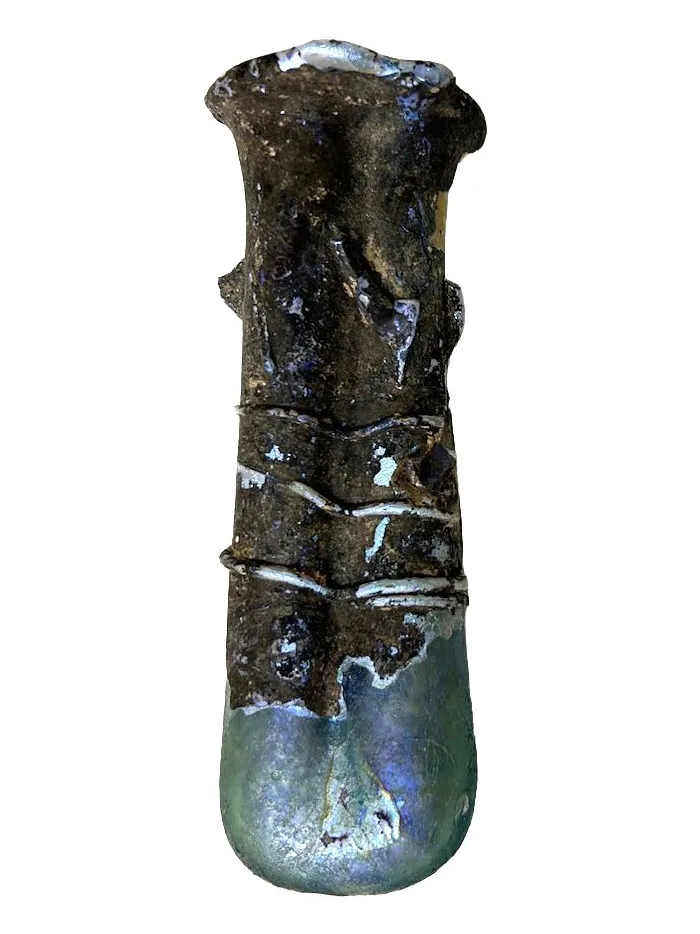
This ancient Roman vial appears to have two separate chambers, however the two chambers join at the bottom, giving it an elongated “U” shape. This type of glass vial contained perfumes and unguents, likely used to anoint the recently deceased. This mold-made vial appears to have been blue originally, a color achieved by adding copper to molten glass. There is notable iridescence present on the bottom of the bottle. This effect was not intentional. This type of iridescence usually appears as the result of decomposition due to the glass’ contact with the acidic soils surrounding it.

Tear Bottle
Roman (Archaeological), Italy
#2023.12.E.59 ● Written by Nick Beckom
Tear bottles, or lachrymatories, are often found in ancient Roman and Greek tombs. Many believe that these bottles were used to hold the tears of mourners and then buried along with the deceased. This, however, is not true. Using chemical analysis, scientists discovered that these glass bottles contained perfumes and unguents which were used to anoint the recently deceased. Bottles of this variety date back to the origins of Roman glass blowing around 100 CE. They were made using molds so that they could be more easily mass produced. The green coloration present in this bottle was likely made by adding iron to the glass during the blowing process.
Jug
Roman (Archaeological), Cyprus or Israel
#2023.12.E.158
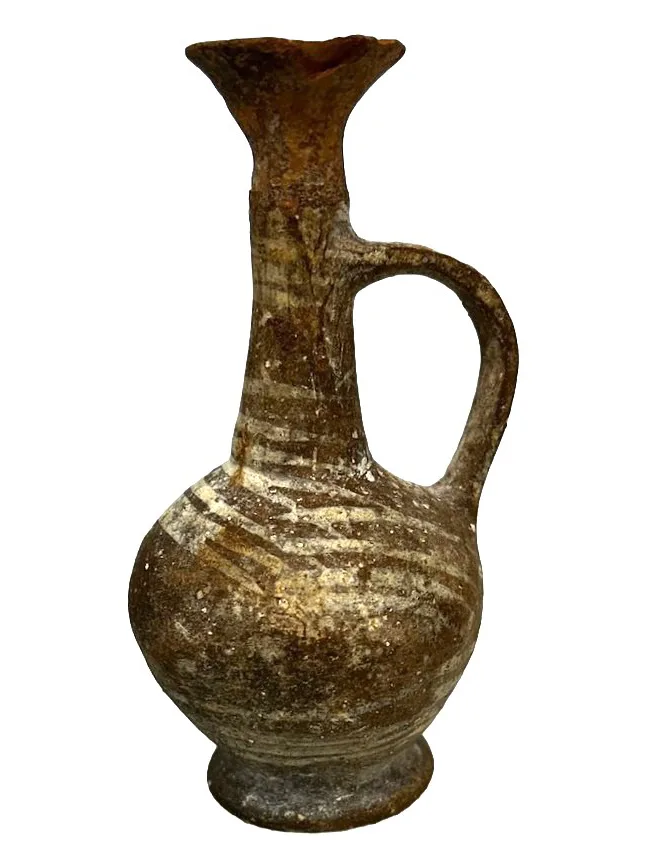
This small vessel was likely used to package and sell oil, wine, or some other expensive liquid. Vessels like this traveled throughout the Roman Empire by the thousands. The crisscrossing white line decoration of this jug is similar to designs from Cyprus, but it was more likely a copy of a Cypriot design done by artists in present-day Israel.
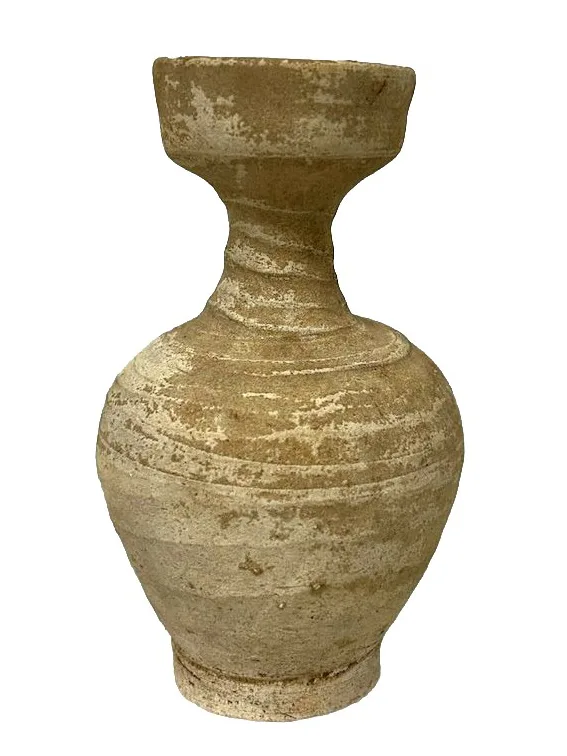
Bottle
Roman (Archaeological), Greece
#2023.12.E.202 ● Written by Arden Beck
This ancient ceramic bottle was used during the Roman Empire as an unguentarium, meaning it most likely held oil to be used in funeral ceremonies. It is classified as a pear-shaped unguentarium because it has a footless rounded body, wide mouth, narrow neck, and small opening. This style was popular during the 1st century CE, and this specific example may have been made by an amateur potter because it is plain and unglazed. The uneven lines visible on the bottle are traces of when it was created. Curiously, there is something inside this ancient Roman bottle that causes it to rattle when shaken–What could it be?