East Asia
These objects from East Asia represent highlights from the UNC-Wilmington Collection, acquired by the Lam Museum to preserve the legacy of the former Museum of World Cultures.
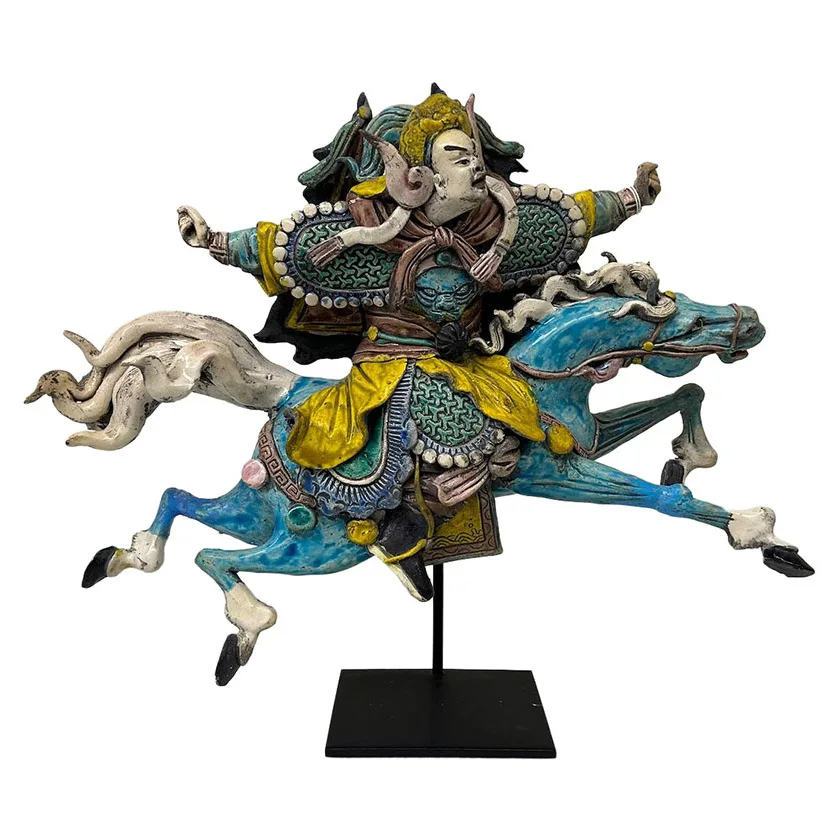
Roof Tile
Chinese, China
#2023.12.E.21.a-b ● Written by Mingyang Zhou
This vibrant figurine, part of Lin Kuang-Yi’s “Warrior Riding” series, exemplifies the Chinese art of Jiaozhi pottery. Created by Lin, a renowned artist and member of the Taiwan Ceramic Society, this piece likely depicts Li Cunxiao, a legendary Tang Dynasty general. The mounted warrior, adorned in blue-green armor with a tiger-head helmet, sits on a blue-green steed with white mane and snow-white hooves – symbolizing strength and nobility. Originally intended as a temple decoration, such figures were believed to ward off evil spirits.
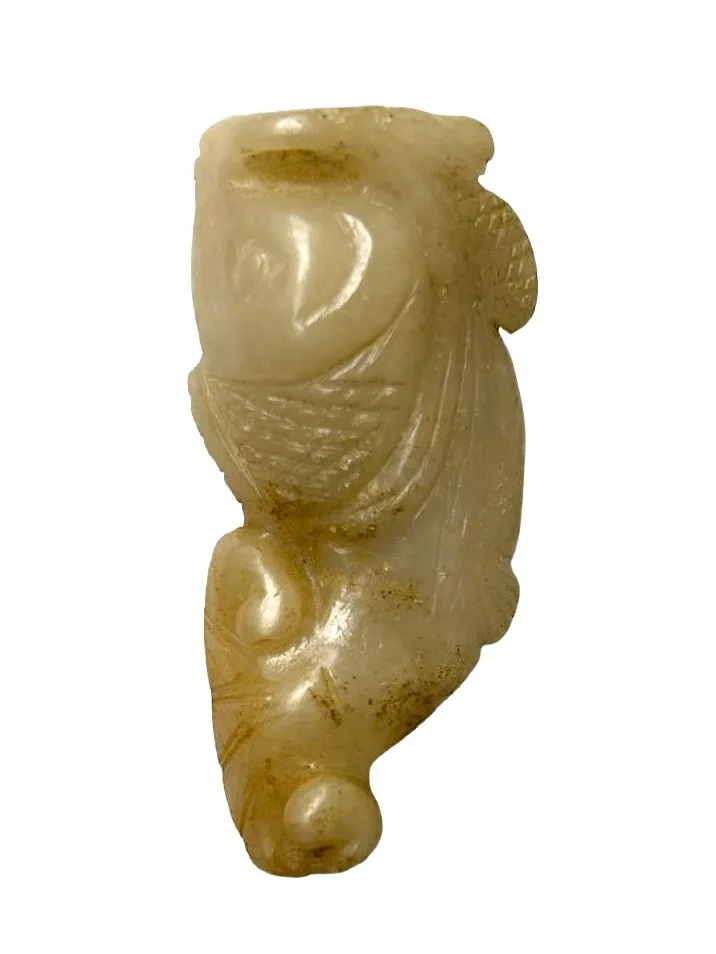
Figurine
Chinese, China
#2023.12.E.47 ● Written by Kevin Lai
This jade figurine was used as a toggle, an anchor point for a string to tie a pouch on to a belt. It is shaped like a fish with its head raised, a popular symbol during the Qing Dynasty (1644-1912 CE) in China. Jade symbolized purity and endurance, while the fish represented prosperity due to the Chinese word for “fish” sounding like the word for “surplus” (鱼 and 余, both pronounced “yu”). This figurine is one of ten toggles collected by the Museum of World Cultures.
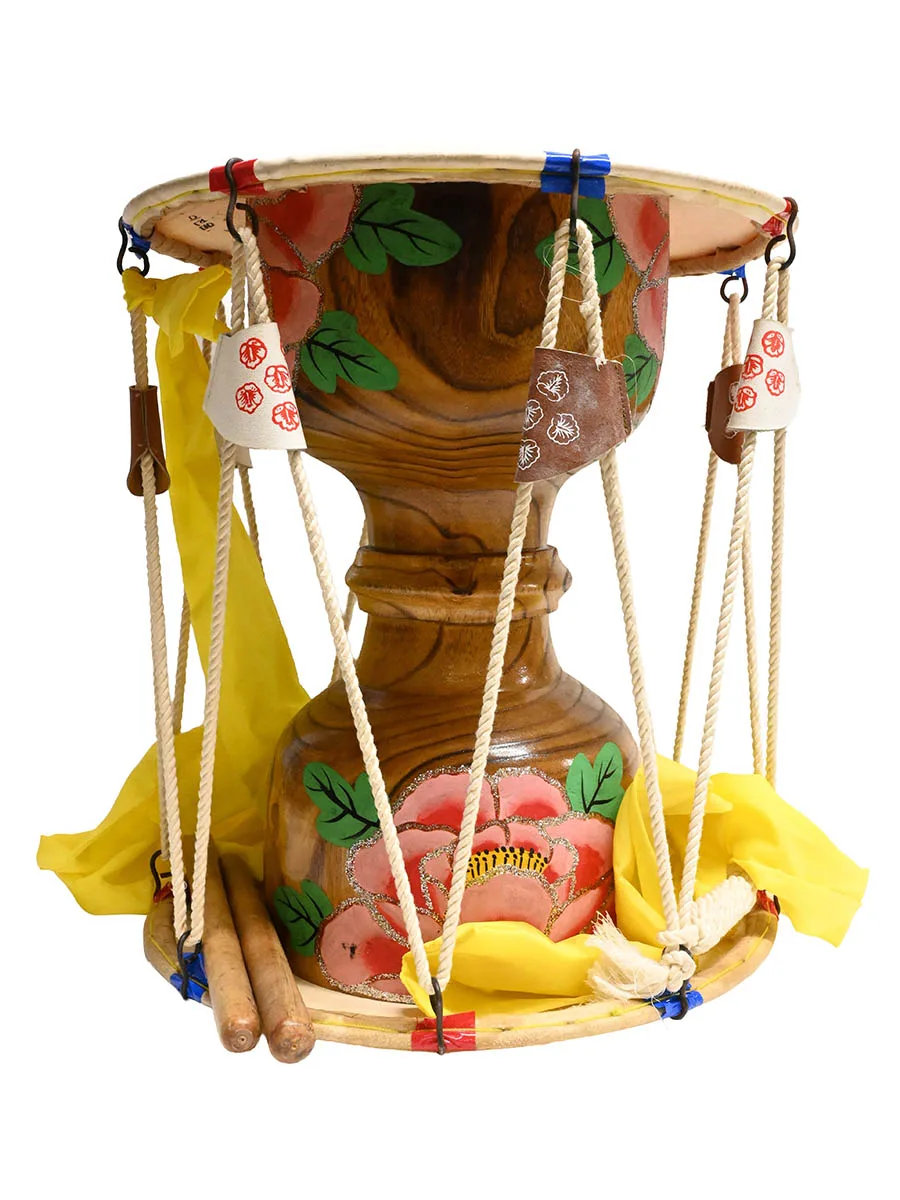
Drum
Korean, South Korea
#2023.12.E.284 ● Written by Becca Wind
Music fills the streets, but a stark sound punctuates it, adding to the emotion of the music. The janggu drum has been a significant part of Korean culture since the Goryeo Dynasty (918-1392 CE). Since then, the janggu is commonly used during festivals, celebrations, and musical performances. Symbolically, the drum is made to represent the union of yin and yang, the philosophical concepts of two opposite but complementary forces that interact to create the universe. Functionally, one side of the drum produces a bass sound and the other a treble.
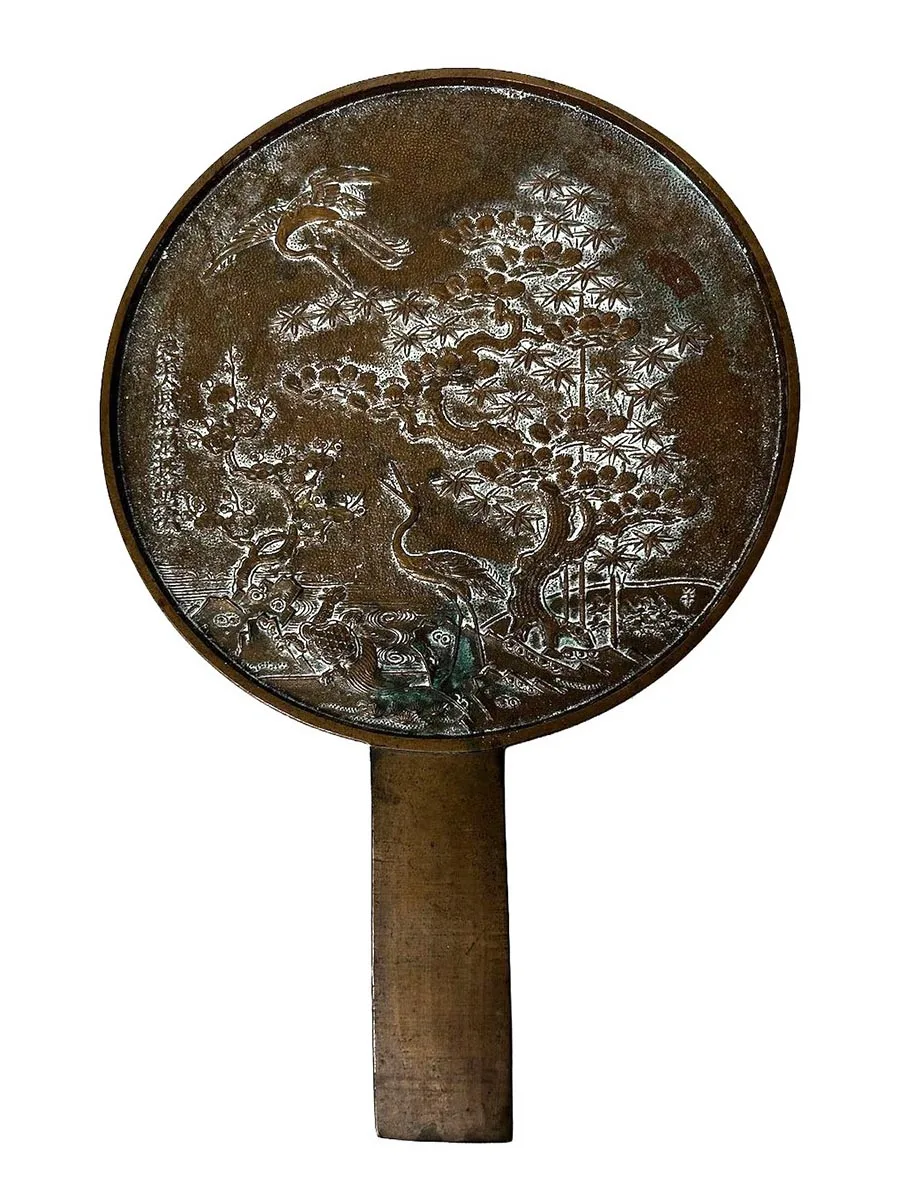
Mirror
Korean, South Korea
#2023.12.E.235 ● Written by Kyra Marty
This brass hand mirror features intricate engravings of cherry blossoms, pine trees, and cranes—symbols of longevity, honor, and pride in Korean culture. The mirror’s weathered surface suggests it was well-used before becoming a collectible artifact. As a mirror, it would have been part of daily beauty rituals, but now as a museum object its function has evolved, becoming an artifact of cultural and symbolic significance as its reflective surface becomes tarnished.
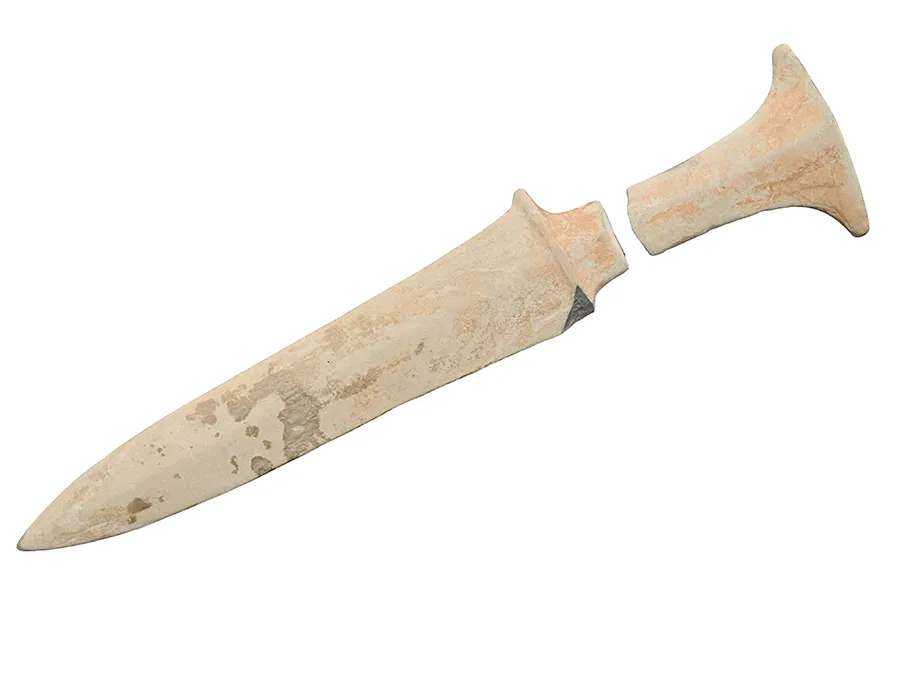
Knife
Korean (Archaeological), South Korea
#2023.12.E.241 ● Written by Colin McGinley
This stone knife was crafted during Korea’s Three Kingdoms period, dating from 18 BCE to 660 CE. Korean societies had long been using metal tools by this time, meaning that a stone knife was likely used by the elite for symbolic purposes. Its possession signified leadership and power by visually evoking both connection to the past (stone) and violence (knife), a common theme within the culture of Iron Age societies. The knife was rediscovered during trench digging operations in the Korean War (1951-1953).

Spear
Japanese, Japan
#2023.12.E.113
Unlike the katana which was wielded only by male samurai, spears were historically used by both female and male samurai, as well as by ordinary foot soldiers. The crossed spear, or jumonji yari, was not thrown like a harpoon but instead used for thrusting and parrying. The crossed bars could catch and trap an attacker’s weapons. As Japan industrialized in the 19th century, archaic weapons like this were replaced with firearms, and many weapons were sold to European and American collectors.
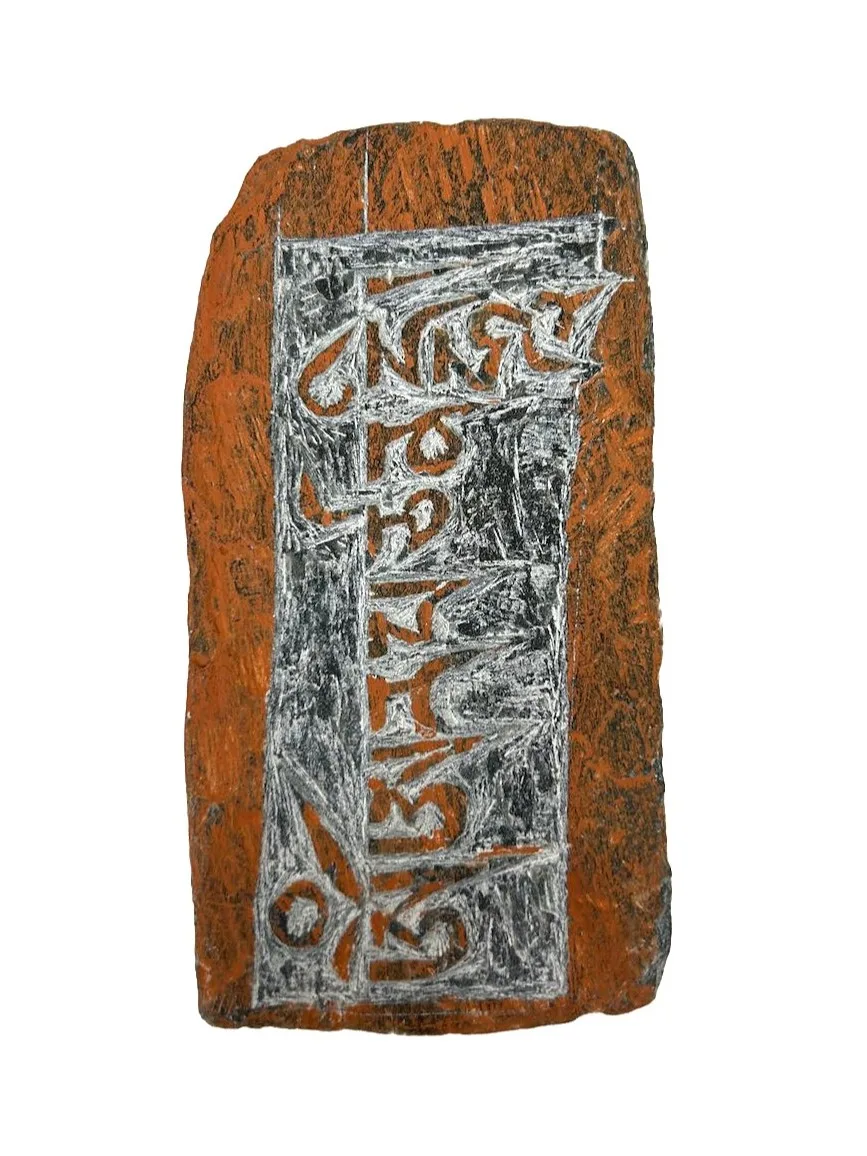
Prayer Stone
Buddhist, Tibet
#2023.12.E.27 ● Written by Trevor Zhi
Prayer stones are rooted in Tibetan Buddhist tradition. This stone is carved with the well-known Sanskrit mantra of “Om mani padme hum,” which roughly translates to “praise to the jewel in the lotus.” This expression symbolizes wisdom and spiritual enlightenment. Traditionally, prayer stones are placed along pilgrimage routes or in sacred spaces, forming small piles of religious offerings.
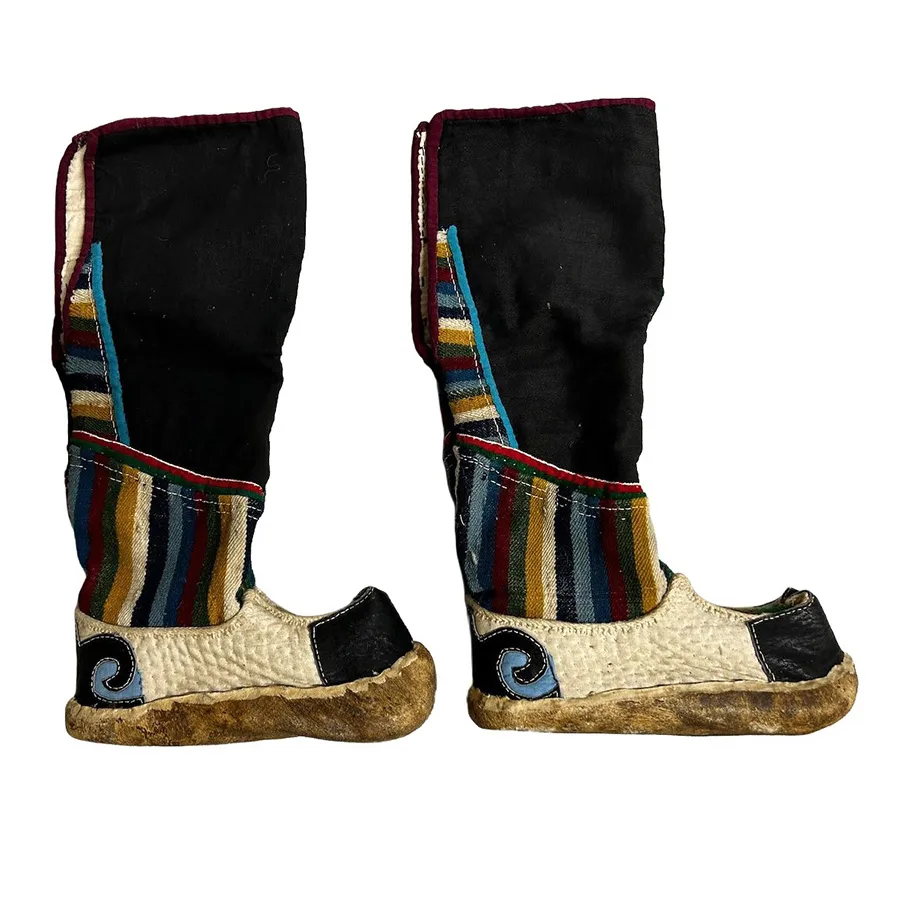
Boots
Buddhist, Tibet
#2023.12.E.169.a-b ● Written by Yizhi Zhang
Designed for the cold and rugged terrain of the Tibetan Plateau, these boots were originally worn as an integral part of daily life. However, they were also a part of religious life. The upturned toes of the boots and the colorful embroidery patterns are not only visually beautiful but also symbolic. Curved toes are believed to protect the people’s feet while maintaining respect for the earth. The vibrant embroidered stripes and swirls represent natural elements such as wind and water, which are commonly associated with Tibetan Buddhism.