
Buddhist Thangka
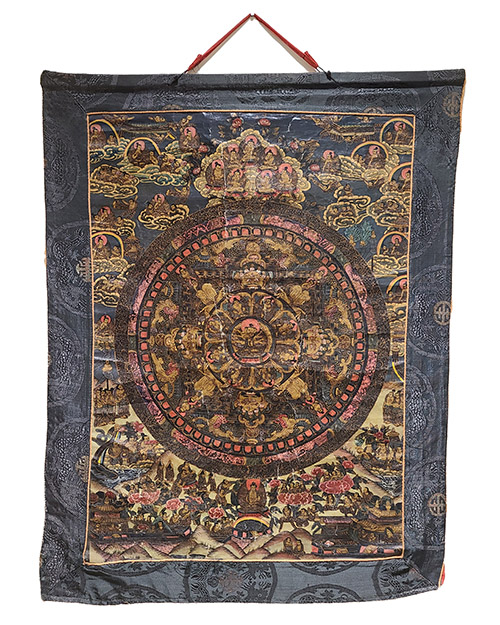
Thangkas are a traditional form of painting associated with Vajrayana Buddhism that is practiced throughout the Himalayan region. In addition to their visual aesthetics, they support meditation, teaching, and ritual practice. Their structures guide attention, regulate perception, and support practices that unfold over time.
Historically, Thangka painters were often Buddhist monks or artists closely affiliated with monasteries. Because Thangkas were used as spiritual aids within the community, they rarely circulated in a commercial sense. In recent decades, however, the conditions of Thangka production have shifted. Commercial demand has led to greater production, meaning formal training has become more accessible, and a wider range of practitioners can now enter the field.
This Thangka from Nepal is likely at least 50 years old. It depicts a Buddhist assembly, or teaching scene. The central figure in the lower part of the composition is the Buddha, Siddharta Gautama, surrounded by a collective audience of mundane humans and bodhisattvas, or enlightened beings, seated on flowers. Deities perched on clouds in the heavens above are also listening. Such group compositions are common in Buddhist scriptures, where the Buddha is shown giving teachings to gathered followers.
The Buddha is depicted in a traditional meditation posture, while the large circular area in the middle of the work represents his lesson on turning the wheel of Dharma. The center of the wheel depicts a deity in the “yab-yum” posture joined with its consort, while the eight figures around it each represent a different moral practice, such as having “right intentions.” Surrounding this circle are four images of enlightened beings and four fanged heads of the god of death, Yama, to give the visual impression of spokes around a wheel.
This Thangka is on exhibit in Seeing as Practice: Entering the World of Thangka through December 11, 2026. Exhibit curator Zhanyi Qi (’26) provided the text for this post.