
Lakota Pipe
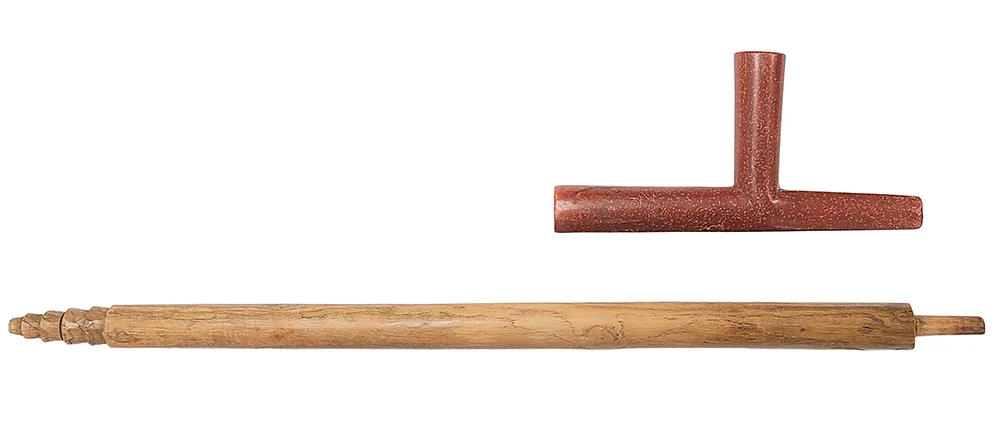
Many American Indian nations on the Great Plains, including the Lakota, would ceremonially smoke tobacco from this type of pipe, known as a calumet, as a part of formal greetings and as a precursor to many rituals. Smoking served as a valuable tool in building relationships between people and with the spirit world. Owners considered the pipes to be extremely important possessions, and they were carried in special hide bags with the bowl separated from the stem. Joining the pieces consecrated the pipe and activated its spiritual powers.
Pipes were also given to visitors as tokens of goodwill. The wooden stem of this pipe is inscribed “To: Lt. H. A. Lemly From: Chief Sitting Bull.” Though it is unclear when it was inscribed, Sitting Bull was known for giving out pipes, and Lemly served as Sitting Bull’s guard, so this attribution seems plausible. Lemly was a Moravian from Bethania, NC, which also explains how the pipe ended up in the Moravian missionary collections that were donated to the Lam Museum.
Wooden pipe stems were usually made from green ash, because the maker could more easily bore out the soft pith in the center with a hot poker. The stems were often carved with spiral or animal forms and decorated with feathers or hide wrappings. The mouthpiece of this stem is carved to represent a rattlesnake’s rattles. Pipe bowls were often carved with a human or animal face looking back at the smoker. Many locally distinct carving traditions developed across the Plains. This pipe bowl is a very simple example.
The most widely used stone for pipe bowls was the reddish soapstone seen here, which is known as pipestone or catlinite, named for artist George Catlin, who first described its use to other European Americans in 1836. It is an ideal material because it does not crack with heat, but it is also soft enough to shape with hand tools. Pipestone is found in only a few locations in Minnesota and Wisconsin. Although the area was controlled by the Dakota during the Historic Period, the quarries were considered neutral ground open to other nations whose members would make pilgrimages to collect the stone. Today, only American Indians are allowed to dig or sell pipestone.
You can learn more about the material culture of the Great Plains through our virtual exhibit At Home on the Plains.