
Huichol Yarn Painting
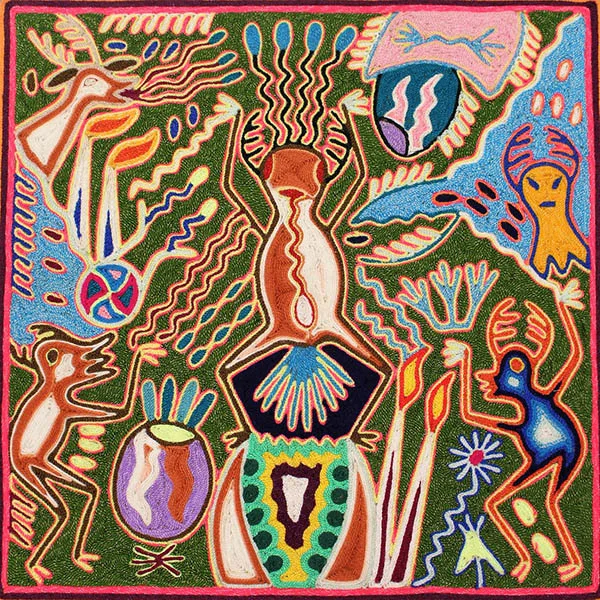
This yarn painting was made by E. Gonzalez Martinez, a Huichol artist from Jalisco, Mexico. The Huichol people, who refer to themselves as the Wixáritari, are an indigenous group who live primarily in the mountainous region of northern Jalisco. They are known for their art, particularly beaded objects and yarn paintings like this one.
Huichol artist Ramón Medina Silva made the first yarn paintings in 1962 in Guadalajara, Mexico. Though he was encouraged to take up this specific art form by a Franciscan priest and an American anthropologist, yarn paintings have their roots in nierikas (also spelled nearika or neali’ka), small wooden boards or discs with a mirror or hole in the center. Huichol shamans create nierikas to represent their visions. They place them in sacred locations as offerings, serving as a powerful form of communication with their pantheon of gods. Shamans use bright colors and elaborate symbols to make nierikas, just as artists do with yarn paintings.
Although Huichol yarn paintings are ultimately a commercial art, most artists retain some religious symbolism in their work, using the medium to convey their beliefs, traditions, and stories. The artist who made this painting explained its symbolism with a note on the back of the board. Translated from the Spanish, it reads: “This painting represents the rain god who is found in the mountain where all the pilgrims go to pay tribute taking their offerings as tributes so that the gods will promise them good health.”
To create a yarn painting, the artist coats a wooden board with sticky beeswax, sometimes adding tree resin as well. The artist then sketches out his vision and presses strands of brightly colored yarn into the wax to fill in the image. Depending on the complexity and size of the painting, artists can take up to six months to complete one piece.
The sale of yarn paintings and other art forms provides an important income stream for Huichol communities.