
Longuda Anthropomorphic Pot
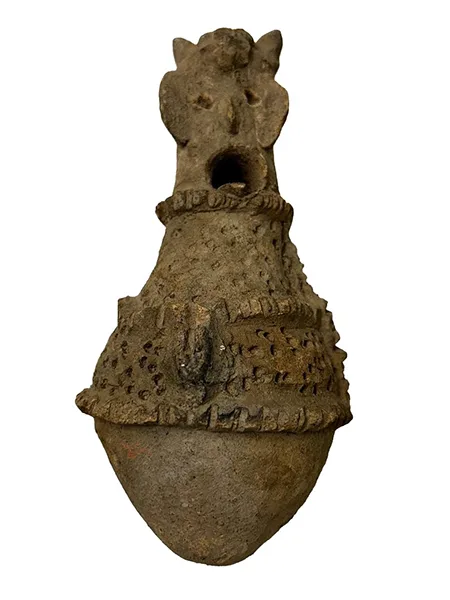
The Longuda people live in northeastern Nigeria, along the eastern banks of the Benue River. Along with their neighbors, the Cham and Mwana people, the Longuda use anthropomorphic pots like this one in traditional healing practices, particularly in the treatment of spiritual disturbances that overlap with mental health issues and neurological disorders. The terracotta pots are known as kwandalowa or kwandalha to the Longuda and itinate to the Cham and Mwana. Though very similar in purpose and appearance, the Longuda pots are made by women, while among the Cham and Mwana, they are made by men.
The Longuda believe that this type of anthropomorphic pot can absorb and hold maladies. In healing rituals, a diviner transfers the illness into a pot, where it can be contained. The diviner first meets with the patient and commissions a potter to make a vessel in a specific design. The potter must be very skilled and knowledgeable about the different forms the diviner may prescribe to ensure that the ritual will be effective. Before the potter begins to form the vessel, she brings the raw clay into contact with the patient to start the process of moving the sickness into the pot. Once complete, the diviner activates the pot, and the patient takes it home. After the patient has been cured, the pot is discarded far from the village.
The appearances of healing pots like this one often evoke illness through rough texture, bumps, scales, or pained expressions. The open mouth is both functional for containing herbal concoctions and symbolic of the vessel’s role in receiving and transmitting healing knowledge.
This pot was recently featured in the exhibit Museum of World Cultures: Highlights from the UNC-Wilmington Collection, which can now be viewed as a virtual exhibit.