
Museum Sponsors Repatriation Workshop
The Lam Museum stewards over 100 artifacts from the Bura Asinda-Sikka culture, whose people lived in present-day Niger during the first and early second millennium CE. In March 2026, the Museum and its research partner, the Art & Antiquities Blockchain Consortium, sponsored a workshop facilitated by Mariam Issoufou Architects Inc. in the Nigerien capital of Niamey. The workshop brought together young people and local creative visionaries to explore the connection between personal identity, archaeological heritage, and the role that upcoming artifact repatriation will play in their communities.
While repatriation has made headlines for a decade, it is often conducted institution-to-institution, with no direct input from the public. We wanted to change this by speaking directly to those impacted. With one of the youngest populations in the world, it made sense to ask Nigerien youth about heritage and stewardship, as they will be the primary beneficiaries of this process.
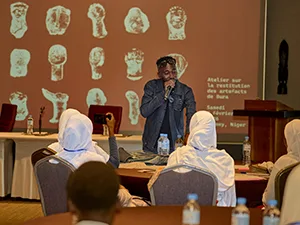
The goal of the workshop was to determine what young people think about these ancient Bura artifacts and about the range of material culture held in Western museums that was often taken under colonialism or stolen by looters. Instead of a traditional focus group, participants expressed themselves through creative media, including writing original poems that reflected on the value of archaeological heritage. Their poetry reveals that youth view these artifacts as part of a shared history and cultural identity, and that their return is part of healing a fractured post-colonial identity.
The initial outcomes of the workshop have been inspiring and have already catalyzed interest among the participating youth in regional archaeology. This knowledge quickly built on itself; following social media coverage, a Nigerien woman who owns three Bura artifacts stepped forward to discuss gifting them to the National Museum of Niger so they can join the pieces returning from the United States. Local creatives are also expanding the conversation through digital campaigns, including a planned TikTok song challenge. This overlap between ancient heritage and contemporary creativity was appreciated by the participants, some of whom are now exploring careers in filmmaking and photography.
Building upon these lessons, plans are underway for a second workshop. This iteration will extend the conversation to the United States by engaging in a live virtual dialogue between Nigerien participants and WFU students. The goal of this dialogue, like the first iteration, is to have an earnest and creative conversation about how each group values the artifacts. This sharing will link the two groups together across 8,000 kilometers and show how the Lam Museum can be an academic leader in the evolving practice of collaborative repatriation.