
Haitian Cut Iron Art
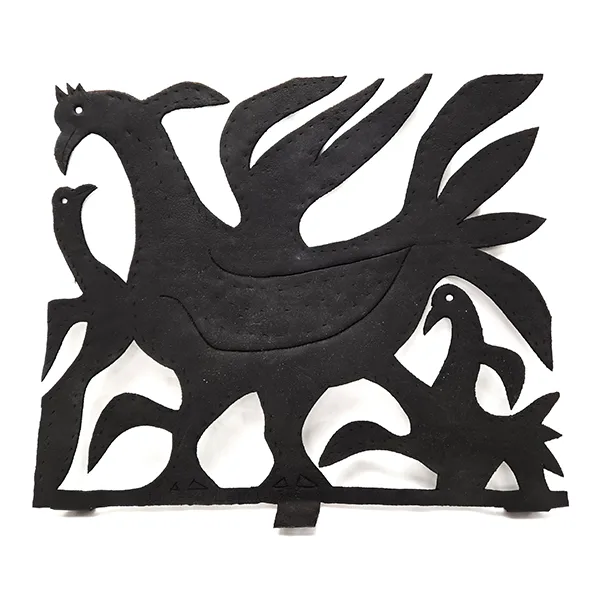
This piece exemplifies the Haitian art form of cut iron (koupe fè in Haitian creole). Haitian metal artists traditionally use discarded oil drums as their base material. To transform them into art pieces, they first cut the lids open and make a long slit down the side of the drum. Next, they light a fire of dried sugarcane, grass, or paper inside the drum to strip the metal. Then the artists flatten and cut the metal into sheets. The artists draw the design in chalk before cutting, hammering, embossing, and bending the heavy metal by hand to form the final piece.
Haitian cut iron art was pioneered in the city of Croix-des-Bouquets in the 1950s by blacksmith Georges Liautaud (1899–1991), who started out making metal crosses for public cemeteries before expanding to more elaborate works. This piece was made by Joseph Louis-Juste (1940-1989), who started working with Liautaud in the 1960s. Joseph is the youngest of the Louis-Juste brothers, whose work gained international acclaim contributing to the spread of the art form. Today, there are hundreds of metal artists sculpting in workshops across the country, but the primary center remains Croix-des-Bouquets.
Birds, like the chickens depicted here, are a common subject for iron artists, but they also draw on many other themes, including scenes from nature, musical bands, and mythical creatures like angels and mermaids. Symbols from Haitian vodun, an Afro-Caribbean religion, are also popular.
By repurposing industrial waste into domestic art, Haitian artists assert their cultural creativity and resilience even when raw materials are difficult to find. This piece’s creation reflects the power of artistic innovation in the face of economic constraints.
Research assistance for this post was provided by Mingyang Zhou (’27).