
Cherokee Pot
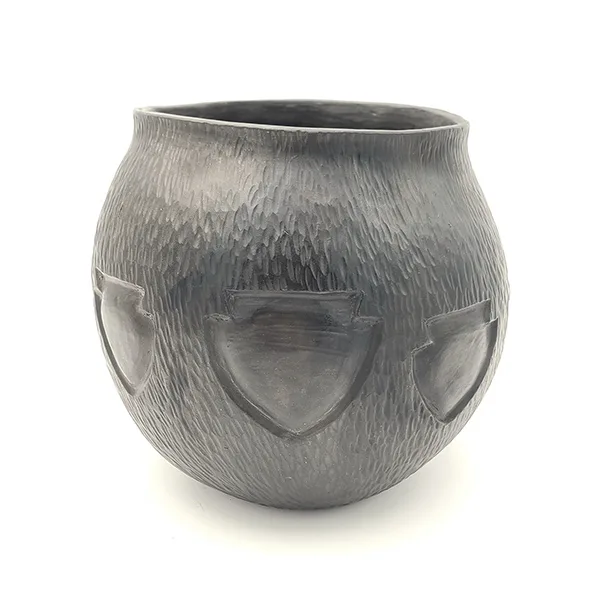
For almost 3,000 years, the Cherokee people have made pottery in Western North Carolina. The oldest Cherokee pots were large, hand-built, thin-walled, waterproof vessels that were stamped with wooden paddles to create rectilinear and curvilinear designs. The Cherokee used these pots for a variety of functional and ceremonial purposes. In the early 1900s, Cherokee potters transitioned almost entirely to hand-building a heavier form of pottery called “blackware” featuring incised decorations rather than stamped. This is commonly referred to as the “traditional” style.
This blackware Cherokee pot was made by Cora Arch Wahnetah (1907-1986). She was born into a family of recognized Cherokee potters and learned coiled and modeled pottery techniques from her mother, Ella Long Arch. She hand-formed her pieces using wooden tools and pit-fired them in a wood fire. Throughout her career, Wahnetah remained faithful to these older pottery traditions, preferring their simplicity over more modern techniques like pottery wheels and kiln firing. In the early 1950s, Wahnetah played a role in the beginnings of the Oconaluftee Indian Village, where she demonstrated pottery techniques for visitors.
Throughout much of the 20th century, tourists provided an important source of income for Cherokee potters. To appeal to this market, potters made more decorative shapes, like this one, though the pots were still made in the traditional style. In 1946, Wahnetah was a charter member of what would become the Qualla Arts and Crafts Mutual cooperative, where this pot was purchased. This is the nation’s oldest Native American cooperative, providing Cherokee artists with a local outlet to sell pottery and other crafts while preserving and promoting their traditions.
You can learn to make a pinch pot with this post from our Cultures Up Close series.